The 2026 World Cup is over. Spain lifted the cup, Argentina played another final, and for 39 days, millions of people followed a competition that surpassed practically every known dimension to date.
It was the World Cup with the most teams, the most matches, the most goals, and the most stadium spectators in history.
But for someone evaluating a real estate investment in Miami, the most important fact isn’t just who won the tournament or how much money FIFA raised.
The truly relevant question begins after the last match:
What remains in a city after hosting one of the largest and most-watched events on the planet?
Because the matches last a few weeks. However, the infrastructure, international exposure, new connections, tourism movement, and global positioning can influence a city for many years.
The World Cup didn’t create Miami’s growth. But it did allow it to be showcased, tested, and to accelerate trends that were already transforming the city.
The 2026 edition was the first contested by 48 national teams, compared to the 32 that participated in previous tournaments.
It was also the first jointly organized by three countries: the United States, Mexico, and Canada.
In total, 104 matches were played in 16 stadiums over 39 days. Teams scored 308 goals, another unprecedented figure for a World Cup.
However, the most striking record was in the stands.
The stadiums welcomed 6,810,966 spectators, far surpassing the previous cumulative record, which belonged to the 1994 United States World Cup.
The average was 65,490 people per match, with the 16 stadiums occupied at 99.7% of their capacity.
Additionally:
It was not simply a sports competition.
It was a global platform for tourism, entertainment, media, advertising, transportation, hospitality, gastronomy, and consumption, operating simultaneously across 16 cities in North America.
The sporting dimension was accompanied by an unprecedented commercial scale.
FIFA had initially projected revenues close to USD 11 billion for the 2023-2026 commercial cycle. Toward the end of the tournament, various reports indicated that the organization estimated reaching approximately USD 15 billion.
It is important to clarify what that figure means.
It is not exclusively the profit produced during the 39 days of the World Cup. It corresponds to the total revenues generated during the 2023-2026 commercial cycle, within which the World Cup represents the main asset: audiovisual rights, sponsors, licensing, ticket sales, hospitality, and other commercial sources.
Even with that clarification, the number helps to understand the economic magnitude achieved.
FIFA also approved the largest economic distribution in the history of the tournament: USD 871 million for the 48 participating federations, including performance prizes, preparation contributions, and other competition-related funding.
The champion received USD 50 million as a sporting prize; the runner-up, USD 33 million; third place, USD 29 million; and fourth place, USD 27 million.
When adding the corresponding preparation contributions, the federations that finished on the podium received:
These amounts are given to the national federations. It does not necessarily mean that this money is distributed entirely or directly among the players, as each association establishes its own agreements and criteria.
The numbers explain why the World Cup was a global sporting and economic phenomenon.
But they still don’t explain why it should matter to a person considering buying property in Miami.
For that, we have to shift the focus.
Miami was one of the 16 host cities and received seven official matches, including knockout games, a quarterfinal match, and the third-place playoff.
During the five weeks of competition, more than 450,000 people attended the matches played in Miami Gardens.
Added to that was the FIFA Fan Festival at Bayfront Park, right in Downtown Miami, which welcomed more than 600,000 residents and visitors over 24 consecutive days.
The region had to deploy a special operation for:
However, it would be a mistake to conclude that hosting the World Cup automatically produces a generalized increase in property values.
An event, no matter how large, does not replace the fundamentals of an investment.
It does not transform a bad location into a good location.
It does not eliminate maintenance costs, taxes, insurance, or rental restrictions.
Nor does it guarantee that a property bought at any price will appreciate in value.
The relationship between a mega-event and the real estate market is more complex.
The World Cup functions primarily as a catalyst.
It can accelerate investments, increase a city’s exposure, test its infrastructure, generate new visitor flows, and reinforce economic trends that were already underway.
That is the perspective from which the case of Miami should be analyzed.
For 39 days, Miami appeared constantly in television broadcasts, social media, international media, tour packages, and tournament-related content.
Millions of people who perhaps associated the city only with its beaches were able to see it as a host of major events, an international transportation hub, a gastronomic destination, a business center, and a gateway between the United States and Latin America.
That exposure does not have an immediate and uniform real estate effect. But it strengthens an asset that is difficult to build: the city’s international brand.
For Miami, that brand is especially important because it competes to attract:
Before the tournament, specialists from Florida International University pointed out that the lasting effect would depend on execution.
If Miami managed to provide a safe, efficient, and memorable experience, the World Cup could become more than a one-month tourism boost: it could function as a long-term investment in the city’s global identity.
A city known to more people, visited by more markets, and perceived as capable of organizing international events gains visibility with future tourists, entrepreneurs, and investors.
Receiving hundreds of thousands of additional visitors required coordinating airports, highways, public transportation, trains, shuttle services, hotels, security, public spaces, and healthcare.
Miami-Dade implemented special connections to the stadium, free services for ticket holders, and a mobility strategy involving various transportation hubs.
Systems like Tri-Rail, Metrorail, Metrobus, and Brightline were part of the regional network used during the event.
Not all of that infrastructure was created exclusively for the World Cup.
And that is precisely the point.
Mega-events usually act as a deadline. They force governments, operators, and private companies to coordinate and improve systems that respond to much more permanent needs:
For the investor, what is relevant is not just how many people used a shuttle during the tournament.
What is important is observing which areas were better connected, which services demonstrated expansion capacity, and which urban corridors will continue to receive investment after the event.
Connectivity influences daily life, access to employment, residential appeal, and a property’s ability to sustain demand over time.
Before the World Cup, various estimates projected an impact of up to USD 1.3 billion for South Florida.
As with all economic impact studies, that figure must be interpreted as a projection and not as money flowing directly and uniformly to every business or property owner in the region.
Hotels, restaurants, transportation, shops, entertainment venues, and short-term rentals saw extraordinary demand.
But not every neighborhood or business captured the same level of activity.
Central areas, large hotels, viewing spaces, and establishments located in tourist corridors were better positioned to receive this flow.
This difference offers a lesson directly applicable to the real estate market:
Large shifts in demand do not benefit all properties equally.
Geographic proximity to a stadium can generate activity during a specific event, but it does not necessarily constitute a long-term investment strategy on its own.
The decisive factor continues to be the combination of:
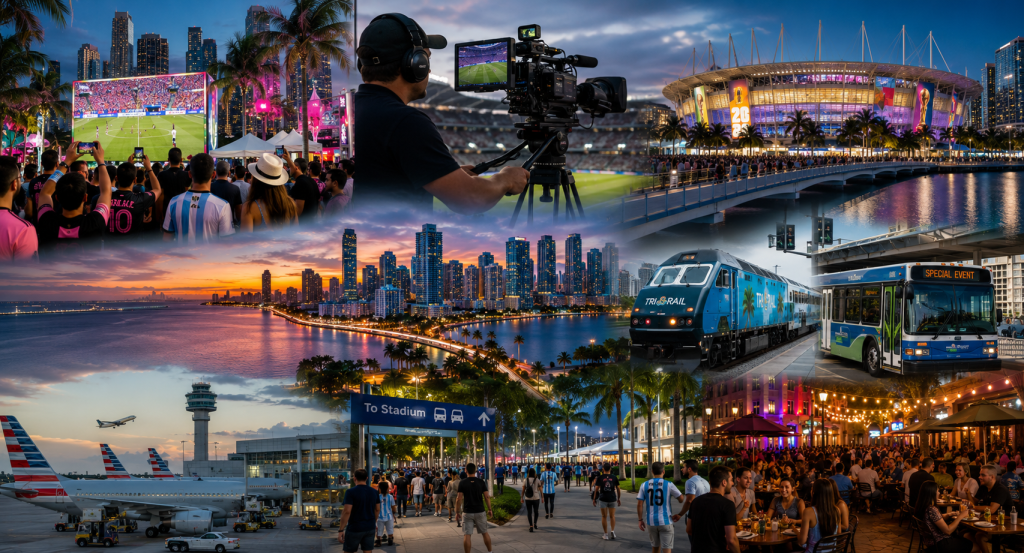
An event of this magnitude generates peaks in occupancy and rates for hotels and short-term rentals.
That can be attractive to owners of units licensed for short-term vacation rentals.
However, projecting the income earned during the World Cup as if it were representative of the entire year would be a mistake.
A vacation rental investment must be analyzed over twelve months, not over seven matches.
Among other variables, one must evaluate:
The World Cup showed that Miami can absorb large peaks in international demand.
But a solid property must also be able to produce income when there isn’t a semifinal, a Fan Festival, or hundreds of thousands of extraordinary visitors.
That’s why, within a flexible rental strategy, it is advisable to prioritize projects with year-round tourist and corporate demand, proximity to activity centers, and clear rules that effectively permit short-term exploitation.
An advertising campaign can show images of a city.
A global event allows people to walk through and experience it.
During the World Cup, visitors from all over the world used the Miami and Fort Lauderdale airports, stayed in the region, and explored areas like Downtown, Brickell, Miami Beach, Wynwood, Aventura, and Hollywood.
Many traveled exclusively for football. Others combined the tournament with vacations, business meetings, family visits, or real estate tours.
There is no automatic conversion between a visitor and a buyer.
But there is a significant shift when a person stops knowing a city only through photographs and begins to understand:
For Miami, where international buyers have a significant share, that reduction in psychological distance can influence future decisions.
Someone who has already visited the city, understands its airport, toured its residential areas, and experienced its level of services is in a better position to evaluate an investment than someone who only observes the market from another country.
The biggest mistake would be to attribute everything happening in the city to the tournament.
Miami was already undergoing a profound transformation before June 2026.
Among the factors that continue to drive the region are:
The World Cup became a part of that transformation.
It was not its sole cause, but rather one of its most visible manifestations.
The city was able to host seven matches and organize an operation of such scale because it already had international air connectivity, hotel capacity, sports infrastructure, tourist appeal, and a recognized brand.
At the same time, the tournament helped amplify those advantages to an extraordinary audience.
After a mega-event, messages often appear promising immediate appreciation or presenting any property as an opportunity.
That is not the proper way to make a real estate decision.
The correct question is not: “Which property is going to go up because the World Cup was played?”
The question should be: “Which areas and types of properties are best positioned to capture the long-term trends that the World Cup helped make visible or accelerate?”
The answer depends on each investor’s objective.
Properties intended for annual rent depend primarily on the permanent demand for housing.
In this case, one must analyze:
The World Cup can strengthen an area’s visibility, but the foundation of this strategy is the everyday need for housing, not extraordinary tourism.
This model can capture tourism, business travel, events, and stays of varying lengths.
In Miami, there are projects that allow short-term rentals, while other buildings impose strict restrictions.
Before buying, it is essential to confirm:
The World Cup may have generated extraordinary weeks. The investment must also work during normal weeks.
Projects under construction can allow capital to be distributed over several years and position oneself before certain urban transformations are completed.
But not all developments offer the same equation.
It is advisable to analyze:
In these cases, the investment should not depend on a supposed “World Cup bump,” but on the comprehensive evolution of the area during the construction period.
The 2026 World Cup broke records for attendance, participation, goals, revenue, and international reach.
It also produced a significant economic movement in the host cities and led millions of people to look at Miami from a new perspective.
But its true real estate impact cannot be measured solely by hotel occupancy in June and July or by the rates obtained during the matches.
It will be measured over time:
A mega-event can accelerate a transformation. It cannot guarantee the result of an investment on its own.
Therefore, investing after the World Cup does not mean chasing the euphoria or buying based solely on a news story.
It means distinguishing what was exceptional from what is part of a deeper trend.
The World Cup lasted 39 days.
The images, the matches, and the records will go down in history. But Miami will continue to grow, welcoming visitors, building infrastructure, and competing to attract residents, businesses, and international capital.
For an investor, the opportunity does not lie in assuming that any property will benefit.
It lies in understanding how the city is transforming, identifying the areas with real fundamentals, and choosing the right type of investment for their goals, capital, and horizon.
The 2026 World Cup put Miami in front of the eyes of the world.
Now a different stage begins: observing which effects remain, which trends consolidate, and where sustainable opportunities may appear.
Whether you’re buying, selling, or need help managing your property, we’re here to assist.
📩 showings@miamitangoinvestments.com
📞 (407) 499-0240
👉 Your next investment opportunity starts with a conversation.

September 1, 2026
Jacksonville is growing by 100+ people per day and has the lowest entry price in Florida. Data, comparison with Miami and Orlando, and how to invest.
Read moreAugust 26, 2026
Zillow’s latest report shows a more stable U.S. real estate market, with increased inventory and better negotiating conditions for buyers. We analyze what this means for Miami, Orlando, and Jacksonville, and why many investors see this stage of the market as a potentially strategic entry point.
Read more
August 10, 2026
South Florida wants to become a major hub for the next technological revolution. With D-Wave setting roots in Boca Raton and millions flowing into quantum research, **“Quantum Beach” is beginning to take shape. But what could this mean for the region’s economy—and its real estate market?**
Read more