While institutional capital is already financing ports, stadiums, and entire districts in downtown Jacksonville, many Latin American investors still have this city off their radar. That is changing quickly — and understanding why could make the difference between buying before or after the market adjusts its prices.
Jacksonville is, by land area, the largest city in the United States (874 square miles) and the 12th largest by population. Its metropolitan area combines a port, defense, healthcare, and financial sectors in an economy that has moved beyond its dependence on tourism — and now offers the lowest real estate entry point among Florida’s major coastal markets.
The city of Jacksonville has 1.02 million residents, while its metropolitan area (five counties) reaches 1.79 million, with sustained growth since 2021. This growth is not a temporary spike: it is structural migration.
+100 new residents per day in the region, according to the U.S. Census Bureau.
97,000+ people in projected net migration to the metro area between 2024 and 2029 (Oxford Economics).
+11% projected population growth from 2023–2028, the fastest among Florida’s major metros (Lightcast).
Housing demand growing at this pace and sustained over time is the foundation of any serious real estate investment thesis.
This is not just a local perception: U.S. rankings confirm it from several different angles.
No. 7 best large city in the U.S. to live in — U.S. News & World Report, 2025.
2nd strongest job market in the country — The Wall Street Journal / Moody’s Analytics.
No. 3 in U.S. economic growth — JAXUSA / Lightcast, 2025.
4th best city in the U.S. to start a business — WalletHub.
Among the top 20 fastest-growing metros in the country — U.S. Census Bureau.
Top destination for young entrepreneurs — Search Logistics, Nov. 2024.
Unlike other Florida destinations, Jacksonville does not depend on tourism. Its economy is diversified across five key pillars:
Logistics and port: JAXPORT, distribution, and international trade.
Finance and fintech: FIS, Black Knight, Nymbus, ICE.
Healthcare: Mayo Clinic, Baptist Health, UF Health.
Defense and military: NAS Jacksonville, NS Mayport.
Aviation and technology: Cecil Airport and new routes at Jacksonville International Airport (JIA).
The metro area’s unemployment rate stood at 4.9% in July 2026, with more than 2,900 net jobs created between July 2025 and July 2026. Intercontinental Exchange (ICE) is expanding its local operations with 500 additional positions, while Cecil Airport is adding a hypersonic testing center with technical jobs paying more than USD 100,000 annually.
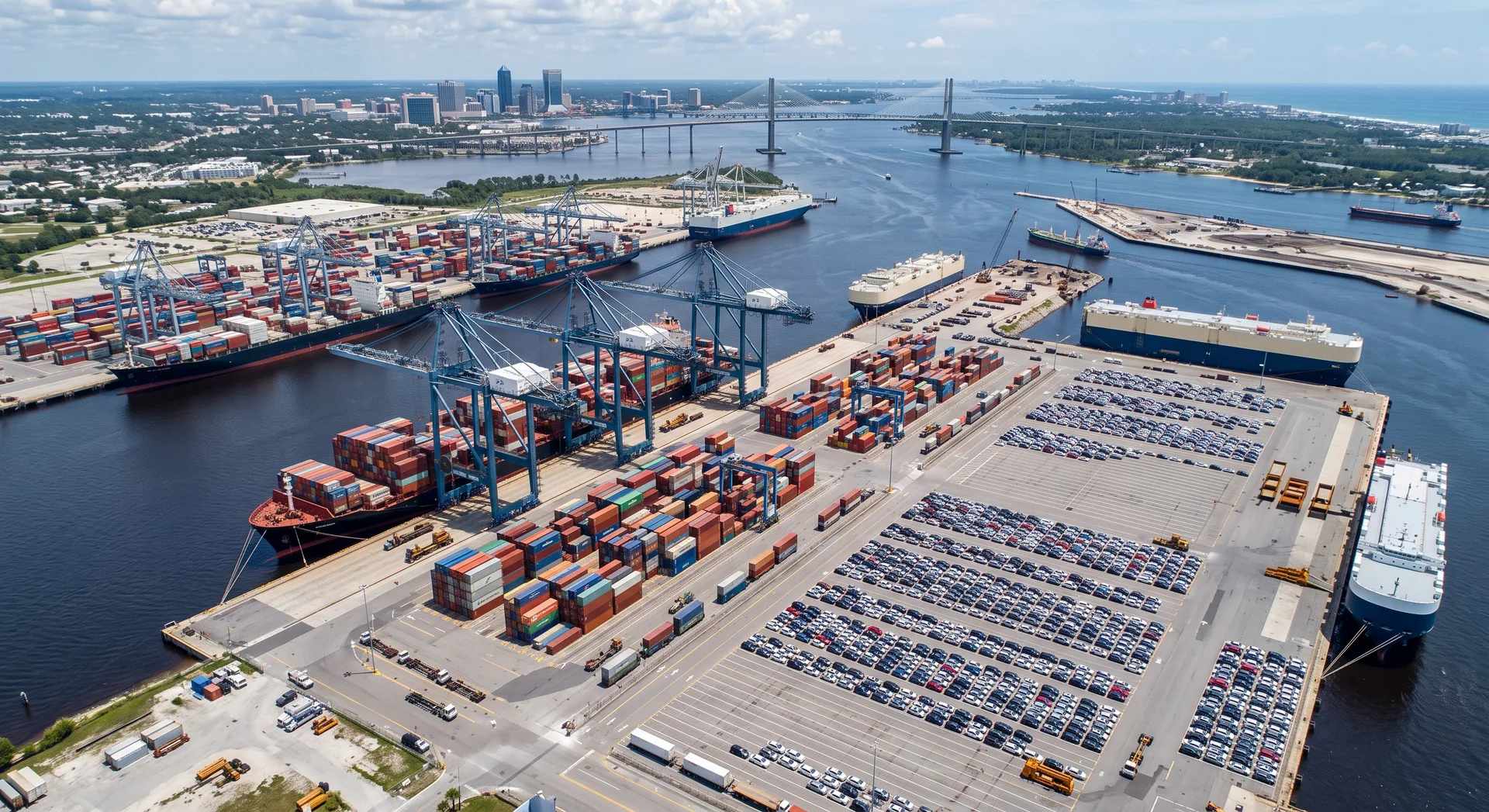
JAXPORT is, quite literally, the logistics engine behind much of this growth — and it is expanding through actual investment, not promises.
~2 million TEUs of annual container capacity after doubling its capacity.
USD 250 million investment in the modernization of Blount Island, announced in 2026.
USD 44 billion in annual economic activity supported by the port.
USD 145 million investment in Southeast Toyota’s new vehicle processing facility.
In 2025, JAXPORT handled nearly 1.4 million containers and 500,000 vehicles. New cranes, a third vehicle berth (Berth 21, USD 60 million, scheduled for completion in 2027), and increased navigation clearance on the St. Johns River (205 feet by the end of 2026) are consolidating Jacksonville as the fastest-growing port in the southeastern United States.
This is the figure that matters most to investors: the median sale price in July 2026 was USD 384,262, approximately 11% below Florida’s statewide median price — making it the most accessible entry point among the state’s major markets, even as prices continue rising across Florida.
The market is also showing signs of healthy balance:
+1.3% year-over-year change in median price (July 2026).
37 days average time on market — faster than a year ago.
96.8% sale-to-list price ratio.
3.1 to 3.9 months of inventory, expanding at a healthy pace.
In practice, investors can currently access this market with residential properties starting at approximately USD 129,000 to USD 198,000, newly built townhomes such as those at Equinox East starting at USD 257,000, as well as luxury condominiums and modern apartments for investors seeking a higher entry ticket. The master-planned developments absorbing the most demand include Nocatee, Wildlight, and Yulee (Nassau County), with the latter benefiting from its proximity to JAXPORT and the I-95 corridor.
Two catalysts with committed capital and defined timelines are reshaping the city center:
The Stadium of the Future. The renovation of EverBank Stadium represents a total investment of more than USD 1.4 billion, with reopening scheduled for August 2028 and a 50/50 public-private financing structure between the Jaguars and the city. A project of this scale along the river typically stimulates hotels, restaurants, offices, and residential development throughout downtown — the same pattern already seen in Miami with Inter Miami’s stadium.
The largest construction cycle in its history. Alongside the stadium, The Shipyards, the new riverfront district led by Shad Khan, is under development. This is complemented by the Four Seasons Hotel & Residences (USD 215–260 million, 170 hotel rooms plus 26 private residences starting at USD 4.72 million, completion in 2027), Gateway Jax (USD 2 billion across five blocks of historic downtown, with Pearl Square adding 500 residential units), and more than USD 230 million in new public spaces, including Riverfront Plaza, Metropolitan Park, and McCoys Creek.
For an investor already familiar with Miami or Orlando, the natural question is where Jacksonville stands in the cycle:
- Miami — mature cycle: median price above USD 550,000, annual appreciation of 3–5%, established international demand, and strong competition for prime assets.
- Orlando — mid-cycle: median price of approximately USD 390,000, driven by tourism and theme parks, strong rental demand, and tighter inventory.
- Jacksonville — early cycle: median price of USD 384,000 (-11% vs. Florida), catalysts with defined timelines and committed capital, structural demand supported by the port and logistics, and greater potential for relative appreciation.
Investing in an early-cycle market, with catalysts of this magnitude already funded, can make the difference between paying for the entire appreciation journey or only for the portion that remains.
Structural migration: more than 100 people per day and 97,000+ in projected net migration by 2029.
Diversified economy: the port, finance, healthcare, and defense sectors support the market through national economic cycles.
Lower entry price: 11% below Florida’s median price, with sustained appreciation.
Catalysts with defined timelines: USD 1.4 billion for the stadium, USD 2 billion for Gateway Jax, and USD 250 million for JAXPORT.
Early cycle: less competition and greater appreciation potential than Miami or Orlando.
No state income tax: Florida’s tax advantage is combined with the state’s most accessible major market.
Is Jacksonville, Florida a good place to invest right now?
Yes, based on current indicators: the city combines the lowest entry price among Florida’s major markets, sustained population migration, and funded investment catalysts — including the stadium, port, and downtown — with defined completion timelines.
How much does it cost to buy a property in Jacksonville?
There are options starting at approximately USD 129,000 for residential properties, newly built townhomes starting at USD 257,000 (such as Equinox East), and higher-value condominiums for investors looking for a larger entry ticket.
Is Jacksonville a better investment than Miami or Orlando?
They are not directly comparable: Miami is in a mature cycle and Orlando in a mid-cycle phase, both with higher entry prices. Jacksonville is in an early cycle, with less competition and greater potential for relative appreciation, making it an attractive option for diversification within Florida.
Why is Jacksonville growing so fast?
A combination of domestic migration toward North Florida, a diversified economy that does not depend on tourism, and major infrastructure projects (JAXPORT, the new stadium, and downtown) are generating jobs and sustained housing demand.
Can foreigners invest in properties in Jacksonville?
Yes. As in the rest of Florida, foreign investors can purchase residential properties in Jacksonville, with structures and processes that a specialized advisor can guide them through from start to finish.
Before the market fully recognizes what institutional capital is already financing — an expanding port, a downtown under construction, and Florida’s lowest entry price — Jacksonville remains an early-cycle opportunity. At Miami Tango Investments, we support Latin American investors throughout the entire process, from property selection to closing.
August 26, 2026
Zillow’s latest report shows a more stable U.S. real estate market, with increased inventory and better negotiating conditions for buyers. We analyze what this means for Miami, Orlando, and Jacksonville, and why many investors see this stage of the market as a potentially strategic entry point.
Read moreAugust 10, 2026
South Florida wants to become a major hub for the next technological revolution. With D-Wave setting roots in Boca Raton and millions flowing into quantum research, **“Quantum Beach” is beginning to take shape. But what could this mean for the region’s economy—and its real estate market?**
Read more
July 29, 2026
Cap rate measures a property's income relative to its value, while cash-on-cash return measures your actual investment performance based on your financing. Both metrics matter for Florida investors, but cash-on-cash better reflects the real returns you'll experience with leverage, especially in today's interest rate environment.
Read more